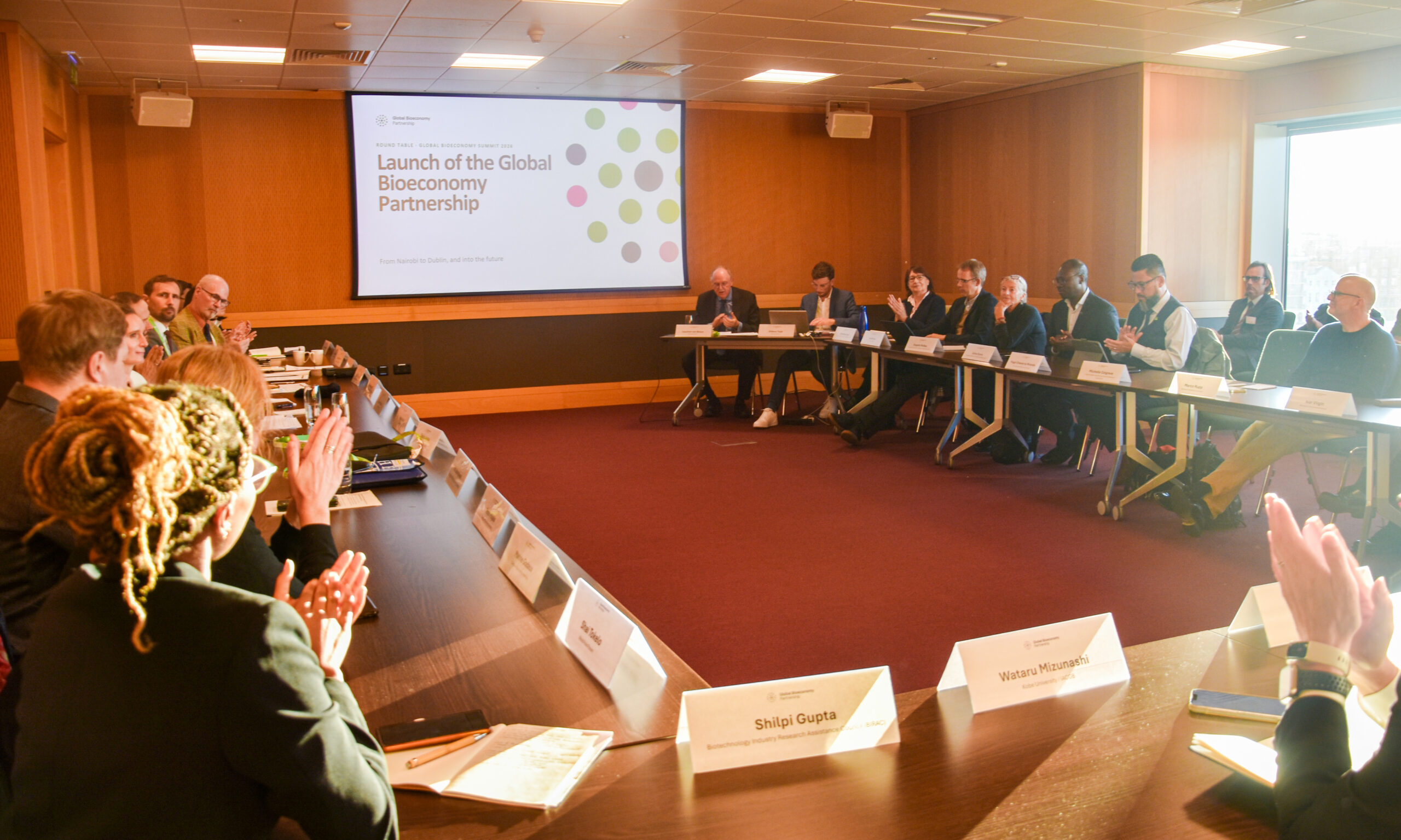
On 19 October 2026, the Global Bioeconomy Partnership was formally launched at a High-Level Round Table at the Global Bioeconomy Summit in Dublin. Representatives of bioeconomy networks, governments, research institutions and industry gathered at the Convention Centre to mark a step that had been in preparation since the 2024 Summit in Nairobi.
Chair Joachim von Braun (ZEF) set out the problem the Partnership answers. The global bioeconomy is maturing fast across continents and sectors, he noted, and that vitality is a sign of strength. Yet networks and initiatives keep proliferating — all pointing in the right direction, too often working in parallel rather than together. The cost is real: mixed messages, duplicated effort, and no shared long-term view of the futures the field actually wants.
A bioeconomy that speaks with one voice can claim its place in the Post-SDG era; a fragmented one will be spoken for.
Joachim von Braun, Chair of the Round Table
Two governments open the session
Olaf Schäfer, Deputy Director-General at the German Federal Ministry for Agriculture, Food and Regional Identity, recalled Germany’s sustained role in advancing the global bioeconomy, including the Ministry’s funding of the BioSummit project — the two-year collaboration between ZEF and the IACGB that conceptualised and built the Partnership.
Daniel Lodetti, Deputy Head of Sustainable Development at Brazil’s Ministry of Foreign Affairs, described the momentum generated through the G20 bioeconomy principles and Brazil’s COP presidency, and saw in the Partnership a vehicle to carry that momentum forward in close alignment with the Summit.
Jan Börner and Christine Lang then presented the Partnership itself: the path from Nairobi to Dublin, the Joint Charter, and the three Bold Bets — positioning the bioeconomy for the Post-SDG era, growing a common understanding, and powering the private-sector transition.
A working discussion, not a round of endorsements
What followed was the part that made the afternoon. Rather than a sequence of prepared statements, the room moved into a genuine working discussion — candid about where coordination is needed and where it is not.
Hugo Chavarria (Latin American Bioeconomy Network) described the Partnership as a bridge between regional experience and global agendas. Iris Lewandowski (European Bioeconomy University) made the case for a hub with think-tank capacity, able to forge joint educational strategies for a sustainable bioeconomy — a role in which the EBU sees its own particular strength. Julie McCarthy (Bioeconomy Challenge) pointed to the strategic moment: with the Post-SDG agenda being written now, the opportunity to pool forces will not come round again. Debisi Araba (AKADEMIYA2063), speaking for a group of African networks that also includes icipe, the Stockholm Environment Institute and EASTECO, set out Africa’s ambition to build shared prosperity through a bioeconomy that advances bio-based trade.
The launch
IACGB Co-chairs Elspeth McRae and Julius Ecuru closed the round table by formally launching the Partnership and thanking the endorsing networks: the International Bioeconomy Forum, the European Bioeconomy University, the Latin American Bioeconomy Network, the African cluster of AKADEMIYA2063, icipe, the Stockholm Environment Institute and EASTECO, and the Circular Bioeconomy Alliance. Conversations continue with further prospective partners, among them the Bioeconomy Challenge, the European Space Agency and the World Economic Forum.
The launch did not stay in the room. Over the remaining days of the Summit, the Partnership was taken up repeatedly from the main stage and in panel discussions, and it found its way into the Summit’s closing communiqué — an early sign that a network-of-networks answers a need the field recognises as its own.
Work now begins: formalising partnerships, turning the three Bold Bets into a joint work programme, and convening in person for the first time in early 2027.
The Joint Charter is available to read and download on this site.